




Services
Meta-noise Company Ltd. provides comprehensive solutions for rail transit noise control, ranging from monitoring equipment and noise barriers to intelligent management systems. Driven by core technologies such as acoustic metamaterials, artificial intelligence, and digital modeling, our portfolio covers diverse noise management scenarios across both near-track and far-field areas.
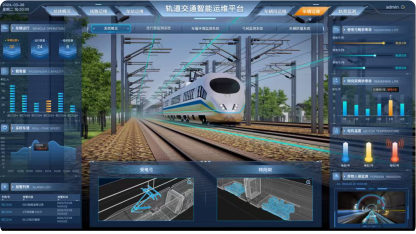
 Railway Noise Monitoring
and Map Reconstruction
System
Meta-noise Company Ltd. provides comprehensive solutions for rail transit noise control, ranging from monitoring equipment and noise barriers to intelligent management systems. Driven by core technologies such as acoustic metamaterials, artificial intelligence, and digital modeling, our portfolio covers diverse noise management scenarios across both near-track and far-field areas.

 Foamed Concrete Metamaterial Near-Track Noise Barrier Series
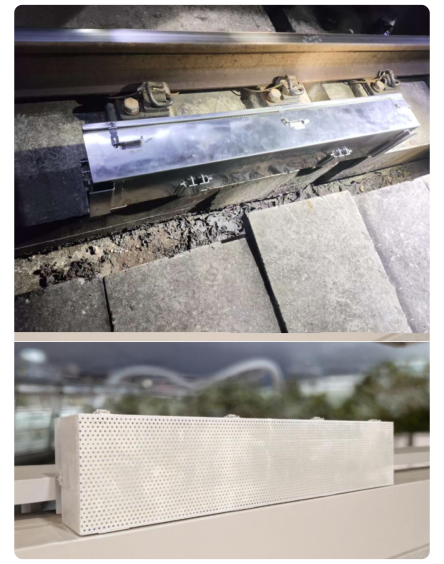
Targeting the mid-to-high frequency range (500 Hz-5 kHz), this model is constructed from low-carbon foamed concrete utilizing recycled industrial materials (rubber, waste concrete, glass). Featuring a multi-layer porous structure and a UHPC (Ultra-High Performance Concrete) perforated panel, it effectively reduces noise while preventing the ingress of debris and rainwater.
Optimized for low-frequency control (10-500 Hz), this model embeds a 3D-printed spatial-coiling acoustic metamaterial within the foamed concrete to achieve precise, targeted acoustic regulation.
Integrating the technologies of the previous two generations, this flagship model achieves efficient broadband sound absorption (100 Hz-5 kHz). Through AI-driven optimization, it provides a comprehensive, one-stop solution for complex noise environments.
Origami Superstructure
Far-Field Noise Barrier Series
(Passive System)
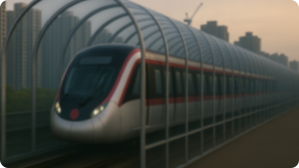
Features a high deployment ratio and low space occupation. Its sound insulation performance is comparable to that of fully enclosed structures, while material costs are reduced by 10-20%.
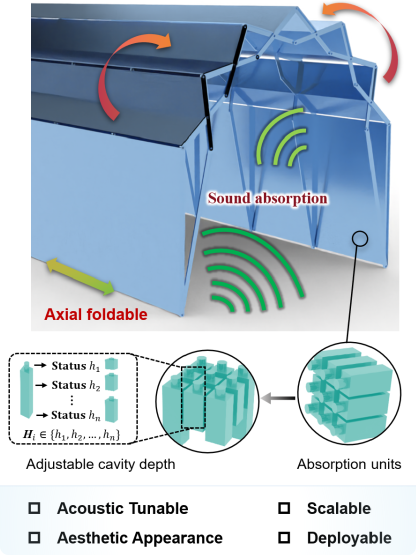
Integrates sound absorption units directly into the deployable structure, enabling effective absorption across a wide frequency range (500 Hz-2 kHz). This design mitigates secondary reflections, significantly improving acoustic comfort for both high-rise residents and passengers.
Combines the capabilities of the aforementioned models with smart adaptability. It supports near-real-time adjustment of sound absorption frequencies, and dynamically responds to external noise changes such as train speed and density to achieve optimal noise reduction effects.